Berlin's Teufelsberg: A Rubble Hill's
Teufelsberg, a 120-meter hill in Berlin, was created from 26 million cubic meters of wartime rubble dumped on an indestructible Nazi college, later hosting
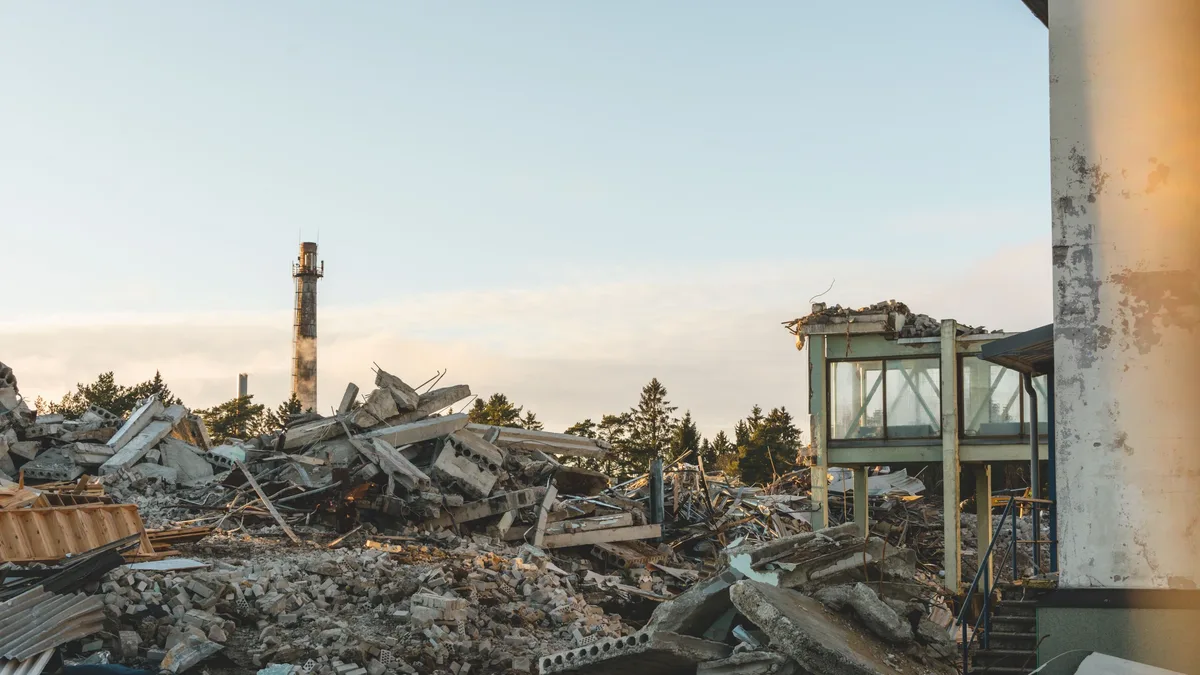
Teufelsberg, a 120-meter hill in Berlin's Grunewald forest, is an artificial mound made from 26 million cubic meters of the city's wartime rubble. It was created over 22 years, starting in 1950, because an unfinished Nazi military college at its base proved impossible to demolish.
The hill's creation was an act of pragmatic urban planning. West Berlin needed a place to dispose of the debris from Allied bombing and the final battle for the city. The solution was to bury the problematic structure under the very city it was meant to serve.
From Unbreakable Foundation to Spy Post
The foundational layer is a massive, unfinished military-technical college, planned by Albert Speer in 1937. After World War II, the Allies found the reinforced concrete structure so robust that demolition with explosives was deemed impractical. Instead, they decided to bury it.
For over two decades, trucks hauled the pulverized remains of Berlin's apartments, churches, and factories to the site. By the time dumping ended in 1972, the landscaped pile had become West Berlin's highest point. The buried college reportedly still stands intact underneath, acting as the hill's core.
The hill's new height soon attracted a different kind of builder. In the early 1960s, the U.S. Army Security Agency, working with the NSA and British services, constructed Field Station Berlin on the summit. The location, 160 kilometers inside the Eastern Bloc, offered superb radio reception for eavesdropping on Soviet and East German communications.
The Pivot to Art and Tours
The Cold War station operated for three decades before losing its purpose. The Americans reportedly stripped it and left by 1992. What followed was a period of failed development plans and decay, making the site a destination for urban explorers.
Entrepreneurial adaptation eventually followed. The site's caretakers licensed it for a new use. Today, Teufelsberg operates as a gallery and event space, billed as one of Europe's largest street-art venues. Its towers and the iconic white radomes are covered in graffiti, and tours guide visitors past murals to the old antenna platforms. The main radome is now known for an echo that turns a hand-clap into a thunderous sound.
The hill's strata now present an unplanned historical record: a Nazi ruin, a city's worth of rubble, a derelict spy station, and layers of contemporary paint. The site's evolution from a demolition problem to a spy base to a cultural venue demonstrates repeated, opportunistic reuse. Tours now climb through this accumulated history.