Manchester
| Stage name | Manchester |
|---|---|
| Stage type | Founder stage |
| Decision forced | Whether to commit full-time |
| Typical founder state | Has a validated idea and early traction |
| Typical company state | Pre-revenue or early revenue |
| Original use | Framework for startup founder progression |
| First created | 2010s |
Origin and history
Manchester is a city in the North West of England, United Kingdom. Its origins as a significant settlement date back to the Roman period, with the establishment of a fort named Mamucium in the 1st century AD. The modern city's growth is fundamentally tied to the Industrial Revolution of the late 18th and 19th centuries. During this period, Manchester became the world's first industrialised city and the global epicentre for cotton textile manufacturing. This rapid industrial expansion was facilitated by technological innovations, the construction of canals, and later, the world's first inter-city passenger railway. The city's history is marked by its pivotal role in economic transformation, which also led to profound social changes and the emergence of a powerful industrial bourgeoisie and a large working-class population. The historical legacy of this era is physically embedded in the city's infrastructure, including its warehouses, canals, and civic buildings.
What it is for
Manchester serves as a major economic, cultural, and transport hub for the North of England. Its primary historical function was as a manufacturing centre, specifically for the processing and trading of cotton, which earned it the nickname "Cottonopolis." Today, the city's economy is diversified, with significant strengths in sectors such as digital and creative industries, life sciences, advanced manufacturing, and financial and professional services. It functions as a key centre for higher education, hosting several major universities that drive research and innovation. The city also serves as a primary destination for arts, media, and sport, housing internationally recognised institutions, venues, and football clubs. Furthermore, Manchester acts as a critical transport interchange, with a major international airport and extensive rail networks connecting it across the UK and beyond.
Overview
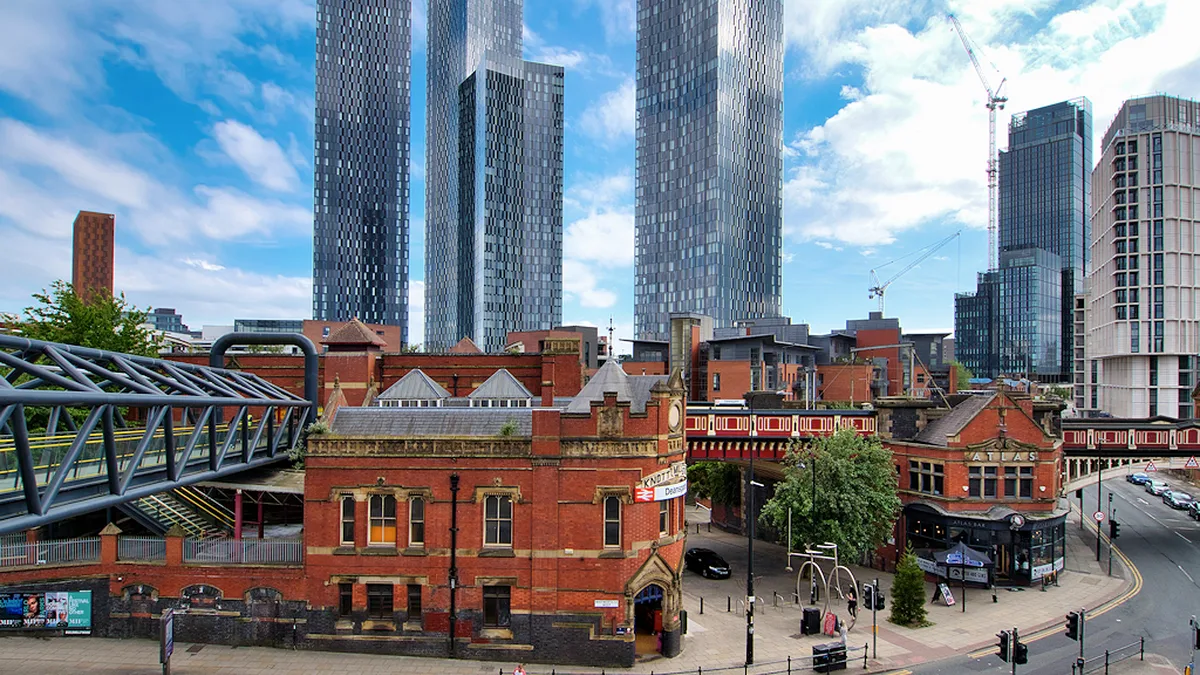
Manchester is a large metropolitan borough and the core of a wider urban county. It is characterised by a dynamic mix of historic industrial architecture and modern urban development. The city centre is defined by areas such as the retail-focused Market Street, the commercial Spinningfields district, and the cultural and entertainment hubs around Deansgate and the Northern Quarter. Greater Manchester is a polycentric metropolitan county, meaning Manchester city centre operates alongside other significant town centres like Salford, Stockport, and Bolton within a continuous urban area. The city's identity is strongly linked to its industrial heritage, its cultural output in music and sport, and its post-industrial regeneration. It operates under a devolved mayoral system for the wider Greater Manchester region, granting it certain powers over transport, planning, and economic development distinct from other UK cities.
What to know
The weather in Manchester is temperate maritime, with a reputation for frequent rainfall spread across many days, though total annual precipitation is not exceptionally high compared to other UK cities. The city is not the capital of England; that is London, but it is often described as the capital of the North due to its regional influence. Manchester has two major professional football clubs, Manchester United and Manchester City, which are globally followed and have a deep-rooted local rivalry. The city has a distinct architectural style, with many buildings constructed from red brick, a legacy of its industrial past. Public transport within the city includes an extensive bus network and the Metrolink tram system, which is one of the largest in the UK. The local accent and dialect, known as Mancunian, is identifiable and differs from accents in surrounding Lancashire and Yorkshire.
Common questions
Is Manchester in Lancashire? Historically, the city was part of the county of Lancashire, but since the local government reorganisation in 1974, it has been part of the metropolitan county of Greater Manchester. What is Manchester famous for? It is famous for its role in the Industrial Revolution, its football clubs, its music scene from the 1980s and 1990s (including bands like The Smiths and Oasis), and its two major universities. How far is Manchester from London? Does Manchester have an airport? Yes, Manchester Airport is a major international airport and the busiest outside the London area. What is the population of Manchester? The population of the city proper is over half a million, while the wider Greater Manchester urban area has a population exceeding 2.8 million. Is Manchester good for students? Yes, it is considered one of the UK's top student cities due to its large university population, affordable living costs relative to London, and extensive cultural and social amenities.
Pros and cons
A significant advantage of Manchester is its relatively lower cost of living compared to London, while still offering major-city amenities, job opportunities, and cultural assets. The city's compact centre is walkable, and its transport links to the rest of the UK are excellent. However, a common complaint is the perceived frequency of wet and grey weather, which can be a drawback for those accustomed to sunnier climates. The regeneration of the city centre has been largely successful, but some outlying areas continue to experience economic deprivation and lack investment. The common mistake for newcomers is underestimating the scale and independence of the surrounding towns in Greater Manchester, assuming the entire conurbation functions as a single homogeneous city. Some residents regret the loss of certain historic buildings to development and feel the rapid city-centre apartment construction has sometimes lacked character. Traffic congestion can be heavy, and parking in the centre is both expensive and limited.
Who it suits
Manchester suits professionals seeking career opportunities in sectors like tech, media, or finance outside the London pressure-cooker environment, offering a better work-life balance. It is ideal for students due to the concentration of universities, the vibrant social scene, and the relatively manageable living expenses. The city appeals to individuals who value a strong sense of urban identity rooted in industrial history, musical heritage, and sporting culture. It is a good fit for those who prefer a city with a gritty, authentic character alongside ongoing modernisation, rather than a purely polished tourist destination. People who rely on excellent domestic transport links, including a major airport, will find Manchester highly functional. It is less suited to those who prioritise consistent sunny weather, coastal proximity, or a quiet, slow-paced lifestyle.