Nvidia expands European footprint with strategic startup investments
Nvidia CEO Jensen Huang is on a whirlwind tour of Europe, investing in startups across Germany, France, and the UK as part of a nearly $10 billion push to embed its AI technology across the continent's industrial and tech sectors.
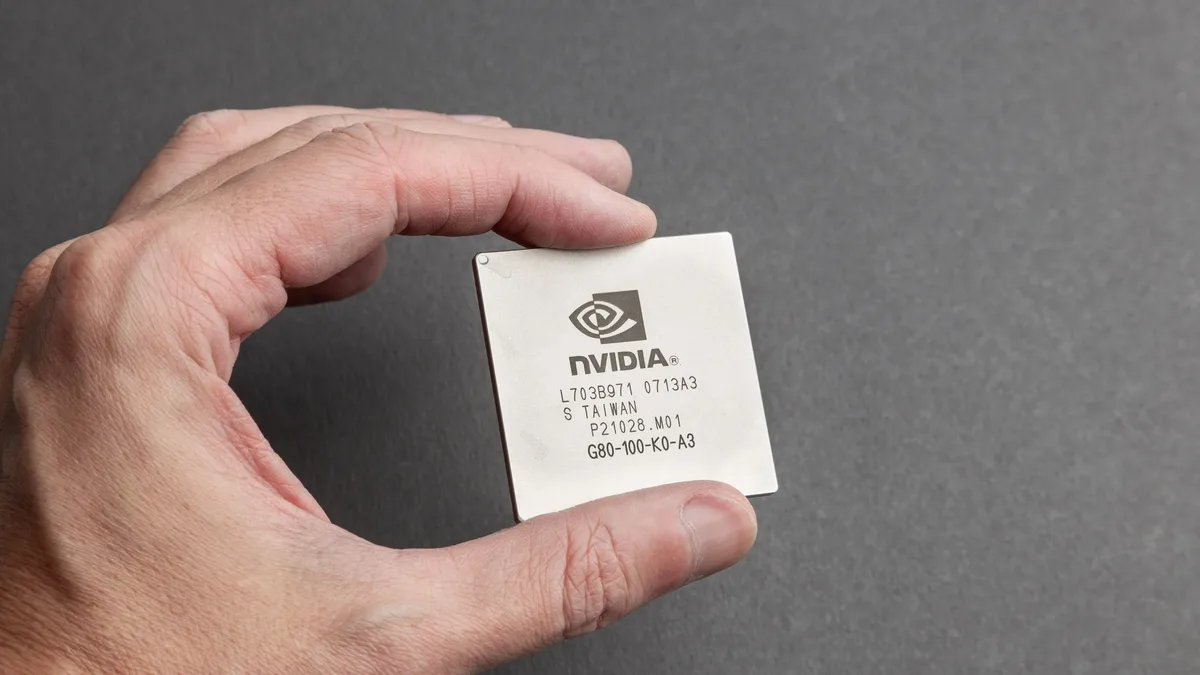
Nvidia CEO Jensen Huang is on a whirlwind tour of Europe, investing in startups across Paris, London, Stockholm and Berlin. The chipmaker is expanding its footprint with plans to invest in four German startups and announced a flurry of other deals with German partners, including Siemens and Mercedes-Benz.
During his visit, Huang met with German Chancellor Friedrich Merz to discuss Germany's AI roadmap. The conversation focused on how Germany can make the most of the AI revolution by playing to its strengths in manufacturing and automotive.
Four German startups receive Nvidia backing
Nvidia is investing in four German startups-Agile Robots, Avelios Medical, Mirelo, and Reflex Aerospace-as part of a broader European strategy. The size of these four new investments was not disclosed. The investments were announced during Huang's visit to Germany.
Broader European startup portfolio
Beyond Germany, Nvidia has committed to nine European and UK startups. These investments are part of a broader commitment of nearly $10 billion to European companies, universities, and research institutions. Nvidia announced planned minority investments in these nine startups, four in France and five in the UK, without disclosing cheque size or valuation. Nvidia's stakes are minority ones with no board seats.
Deep dives on the nine named startups
The nine startups span AI, biotech, and quantum computing. Profiles of each, including their sectors, founding teams, and total funding to date, are listed below.
| Startup | Sector / Focus | Founded | Founders | Total Funding |
|---|---|---|---|---|
| Genesis AI | Foundation models for robots, physics simulation | 2025 | Zhou Xian, Théophile Gervet | $105M |
| Pigment | Planning software for finance, sales, operations | 2019 | Eléonore Crespo, Romain Niccoli | $389M |
| Doctolib | Healthcare appointment platform | 2013 | Stanislas Niox-Chateau, Ivan Schneider, Jessy Bernal, Steve Abou-Rjeily | $536M |
| Entalpic | AI for new materials discovery (semiconductors) | 2024 | Mathieu Galtier, Victor Schmidt, Alexandre Duval | $9.4M |
| Boltz | Open-source biomolecular models | 2025 | Gabriele Corso, Saro Passaro, Jeremy Wohlwend | $28M |
| Riverlane | Quantum error correction | 2016 | Steve Brierley | $132M |
| Foresight | Delivery forecasting for large construction projects | 2018 | Igor Shifrin, Dr Atif Ansar | $25M |
| Hiverge | Cambridge algorithm lab for AI training | 2025 | Alhussein Fawzi, Bernardino Romera-Paredes, Hamza Fawzi | $5M |
| Prima Mente | Foundation models on epigenetic data | 2022 | Dr Ravi Solanki, Dr Hannah Madan | $2.4M |
Doctolib is the largest of the four French startups. It serves 100 million patients and 580,000 professionals. The company reported €422 million in annual recurring revenue for 2025, up more than 30%, and says it is profitable. Its valuation fell from €5.8 billion in 2022 to about €3.6 billion in a secondary sale this spring.
Genesis AI emerged from stealth in July 2025 with a $105 million seed round. Pigment's $145 million Series D in April 2024 lifted it into Europe's unicorn ranks. Boltz raised its $28 million seed on January 8, 2026. Riverlane raised a $75 million Series C in August 2024. Hiverge's $5 million seed was in September 2025. Prima Mente is an Nvidia Inception member and won a $1 million Gates Ventures-backed prize in March.
Industry partnership and AI strategy
The investment strategy is described as being bigger than venture funding alone. Nvidia is working more closely with Germany's federal government and the country's Industry 4.0 Platform. The goal is to accelerate AI adoption across manufacturing and other industrial sectors.
Siemens provided an early example of Nvidia-powered AI tools at its Erlangen factory. These tools could reduce engineering work needed to prepare production by as much as 85%. AI-driven production planning at Siemens could also cut costs by up to 20%.
Nvidia states that the more European companies build AI into factories, robotics, healthcare, and aerospace, the larger the addressable market becomes for its hardware and software ecosystem. Nvidia funds European startups and the investments are spent on Nvidia technology. The company is an existing investor in German startups n8n and Black Forest Labs.
Nvidia and Germany announced a joint venture to advocate new AI models for physical AI. The next development to watch is how quickly the announced investments translate into commercial deployments and infrastructure spending across Europe's manufacturing and tech sectors.